The following memories were recorded by Curtis R. Burke, 14th Kentucky Calvary, Co. B. He paints such a compelling picture of the Battle of Corydon, it seemed only fitting to present his work as a whole.
Thursday, July 9th, 1863. Weather pleasant. About sun up we saddled up and moved a few miles and stopped in a lot near a house. We got plenty of corn from the crib. There was a large pond in the center of the lot. Henry Bethods of company A was wounded in the arm accidentally by a shot from a pistol in hands of John Camdon of the same company who was cleaning it at the time. The boys got all of the meat and bread in the house then got into the milk, butter and preserves in the diary. On these I made a good breakfast. We had some bushwhackers at the house prisoners and some boys scared them very much by telling them that General Morgan was going to shoot them. The lady of the house appeared to be in a great stew or fret. I suppose her weight was something near two hundred and fifty. As soon as our horses were done eating we moved on. About ten o’clock the advance guard was fired on by men in the bushes who would fire and run. Our advance guard was from the regiment, each company being represented and were led by Winder Monroe. When we got about three miles from Corydon John Dunn of company D or Capt. Hines Co. was killed from a house. Hutty Hutchison [M. Hutcherson] and several others of my company received orders to burn the house. Hutchison went in and the woman declared that there was no men or arms in the house and begged Hutchison not to burn the house. He paid no attention to her but got fire from the stove and commenced firing the beds and bookcase. In a few minutes the old man and young son came bouncing down stairs and tried to put the fire out. Hutchison attempted to stop the old man and the old fellow the pitched into him and tired to take his carbine from him. In the scuffle Hutchison found that the old man was stronger than he was and determined to use his carbine if he could. He soon managed to get the muzzle of his gun against the old man’s thigh and fired. The old man still contended for the gun. Hutchison called to Huston Garvin to shoot him! Shoot him!! Garvin then cocked his gun and pressed the muzzle against the old man’s side. The old man instantly released his grip on the gun and said, “I give up.” Being weak from his wound he staggered out and laid down in the yard. The flow of blood could not be stopped and the old man soon bled to death. By this time the house was all in flames. The women made a great fuss over it. There seems to have been a good many loaded guns in the upper story of the house for a good many reports were distinctly heard above the roar of the flames. During the above Transaction the regiment was halted in the road. We then received orders to go on a scout to the right of Corydon. A guide was furnished us and we took a road to the right through the woods and went a mile or so when the advance caught sight of some bushwhackers and we all put out after them on a double quick. Turning a corner to the right at a house where some women and children were crying I saw a fine pair of boots on the side of the road that some of the boys ahead had dropped. I thought that I would have time to stop and get them so I rode out, dismounted, and got the. Just then a heavy volley was fired into us from the woods just about [a] stone’s throw ahead. My horse was restless and before I could mount, the rear of my company closed up and dismounted to fight and I could not get to my position in the first section. I was holding my horse and five or six reins was partly forced into my hands. The boys thinking I was a No. 3 or horse holder. Before I could turn around our boys had taken to the trees. The bullets came pretty thick and low but our boys soon made the work too hot for the bushwhackers and they run taking off their wounded and leaving one man dead on the field. The causalities on our side was M. Johnson got his foot shattered, Charles Bess [or Best] got a deep graze on the side of his head, both of the advance guard. R. S. Porter of Co. C got a shot in his hand, L. P. Thorp badly wounded in the shoulder. The wounded and a couple of prisoners we had captured in the skirmish were sent to the rear. Then we all mounted and took a road to the right through the woods on a double quick, the guide keeping in front with the advance and the advance from twenty five to a hundred yards in advance of the regiment. We went about three miles bearing a little to the left when the advance vidette sent word back that the bushwhackers were ahead. We galloped into a large stubble field and formed a line in the center of the field on a double quick. As fast as the companies got into line they dismounted to fight, then we double quicked about fifty yards to the top of a little rise in front of a house which brought us within a hundred yards of a clump of trees where a group of about a dozen mounted men had just ridden up. “There they are! Give it to them boys!” ran along our line. I had a fair shot. They broke without returning the fire leaving one man dead. We followed them about a hundred yards or so loading as we run. Some got two shots. I did not get a second. We could see the bushwhackers and home guards galloping past us on the pike some distance below us into Corydon. We could see Corydon on our left. Our horses came up and we mounted and went to the pike, then took right down the pike about two hundred yards to a house. The regiment formed behind the house in an orchard and company B (my company) dismounted and got in an old log stable on the side of the pike to keep the yanks from escaping from town on that road as our forces were all around town and we felt sure of taking it. We had a clear view of the pike for about two hundred yards and good cracks between the logs of the stable to shoot from both below and in the left. I laid a lot of my cartridge in a trough before me hoping to get a chance to use them soon. We waited for half an hour, one person made his appearance and we captured him and returned to the regiment. There was a dozen or so home guards came up the pike from the country but on seeing us they halted. The boys hollowed to them to come on, that we would whip the robbers and etc. So they took it for granted that we were home guards also, so they came right up and were very much surprised when they were informed that they were prisoners in the hands of Morgan’s men. There was another lot came in sight and halted. The boys had a considerable argument whether they were our men or Yanks. We all looked so much alike. We knew there was other scouts out from command besides ourselves. We tired to call this second lot to us, but they would not come. Some of the boys saw bayonets in their crowd and decided they were Yanks and fired at them and they broke back. One of the first prisoners said that there was a wagon load of provisions cooked just behind the party that we drove back and if we had fired we would have captured the wagon. The boys regretted very much not getting hold of the wagon. The prisoners said that they were going to Corydon in compliance with a general order to help drive the rebels out of the country. They were on foot. Some of the officers paroled them to go back home. Then we mounted and moved towards Corydon falling in with one of our regiments coming from the direction that we had come. We stopped at a place where about two companies of the enemy had surrendered and ground their arms. Several of us tried to trade off our old muskets for better guns, but the guard over them would not let us change. WE received news that Corydon had been surrendered, and moved on. As we passed the toll gate I saw among a scared looking group of women and children the large lady that lived at the house where we fed that morning. She hollowed to us, “Oh please don’t kill anybody or burn the town. Everybody has surrendered.” As we entered Corydon we sung The Bonnie Blue Flag. As we passed through town I noticed that every house was shut up and our men and the prisoners, some seven or eight hundred in number, were crowded in the streets. The houses were mostly white frame buildings. It is not a very large place but a tolerable good looking lace. We took the Salem pike, dismounting to fight five or six times in an hour. At one place my company was thrown out as skirmishers and went to a house looking for some home guards that went in that direction. The lady said that about twenty five men just went in that direction. The lady said that herself and her husband had never openly taken sides on either side, but stood neutral. We went no farther but returned to our regiment. At another place the advance came to a halt on a rise in the road. There was some mounted home guards near a house and stable in a bottom, cleared piece of land. My company was sent around the hillside to the left through the woods to get in the rear. The woods was very thick with undergrowth. We could scarcely keep our seats in the saddle riding single file. WE got into the position we wished but the game had fled with two exceptions. The advanced fired on them and got their horses. We galloped to the next house and halted till all got up, then moved on passing through the village of Palmyra, Ind. And halted to camp two miles beyond, about dusk, at a good looking house. We were all very tired and getting sleepy. Myself, Wm. Gibbons, Henry White, and others was called out on a detail for picket before going into camp. We immediately went down the road to the next house about a quarter of a mile and made it our base. There was a cross road a hundred yards below where the pickets stood. The family at the house were Dutch. We got plenty [of] corn for our horses and meat, bread, milk, cheese, and butter for ourselves, and no charge. One of the boys gave him a pair of ladies slippers as a present. He professed to be a little secesh but had to keep neutral. I and Henry White made a bed near our horses of our extra blankets. There was fifteen of us all together. I and William Gibbons stood together from three o’clock until five o’clock. We could hear bells ringing and cars whistling all through the night. Just before sun up the advance of the command commenced passing and we were relieved, but remained at the picket base.
The Bonnie Blue Flag
Harry McCarthy
We are a band of brothers and native to the soil,
Fighting for the property we gained by honest toil;
And when our rights were threatened, the cry rose near and far,
"Hurrah for the Bonnie Blue Flag that bears a single star!"
Hurrah! Hurrah! For Southern rights hurrah!
Hurrah for the Bonnie Blue Flag that bears a single star.
As long as the Union was faithful to her trust,
Like friends and like brothers both kind were we and just;
But now, when Northern treachery attempts our rights to mar,
We hoist on high the Bonnie Blue Flag that bears a single star.
Hurrah! Hurrah! For Southern rights hurrah!
Hurrah for the Bonnie Blue Flag that bears a single star.
First gallant South Carolina nobly made the stand,
Then came Alabama, who took her by the hand;
Next quickly Mississippi, Georgia and Florida,
All raised on high the Bonnie Blue Flag that bears a single star.
Hurrah! Hurrah! For Southern rights hurrah!
Hurrah for the Bonnie Blue Flag that bears a single star.
Ye men of valor, gather round the banner of the right,
Texas and fair Louisiana join us in the fight;
Davis, our loved president, and Stephens statesman are,
Now rally round the Bonnie Blue Flag that bears a single star.
Hurrah! Hurrah! For Southern rights hurrah!
Hurrah for the Bonnie Blue Flag that bears a single star.
And here's to old Virginia, the Old Dominion State,
Who with the young Confederacy at length has linked her fate;
Impelled by her example, now other states prepare,
To hoist on high the Bonnie Blue Flag that bears a single star.
Hurrah! Hurrah! For Southern rights hurrah!
Hurrah for the Bonnie Blue Flag that bears a single star.
Then cheer, boys, cheer, raise the joyous shout,
For Arkansas and North Carolina now have both gone out;
And let another rousing cheer for Tennessee be given,
The single star of the Bonnie Blue Flag has grown to be eleven.
Hurrah! Hurrah! For Southern rights hurrah!
Hurrah for the Bonnie Blue Flag that bears a single star.
Then here's to our Confederacy, strong are we and brave,
Like patriots of old we'll fight our heritage to save;
And rather than submit to shame, to die we would prefer,
So cheer for the Bonnie Blue Flag that bears a single star.
Hurrah! Hurrah! For Southern rights hurrah!
Hurrah for the Bonnie Blue Flag that bears a single star.
Showing posts with label Corydon. Show all posts
Showing posts with label Corydon. Show all posts
Wednesday, December 31, 2008


Monday, December 29, 2008
CORYDON
“We attacked Corydon this evening, and, after a tolerable severe fight for two hours, took the place and several hundred prisoners. Thence to Salisberry, where we bivouacked for a few hours.”
~ Lt. Col. James B. McCreary, 11th Kentucky Cavalry CSA[i]
Early on July 9th, John Hunt Morgan selected his brother Colonel Richard “Dick” Morgan to lead a group of scouts northward over the Mauckport Road. About twelve miles from their crossing point, south of town of Corydon, the Raiders found their way blocked the Harrison County Home Guard who had barricaded themselves behind fallen logs. This small force of 450 men, officially designated as the 6th Regiment, Indiana Legion was under the command of Colonel Lewis Jordan. Jordan had positioned his men to block access to Corydon from the south. While a number of the Home Guard had the advantage of being equipped with Henry rifles which could fire 14 rounds without reloading, the Raiders outnumbered the little Indiana force by four to one. Morgan used his Parrot guns to further his advantage. The Hoosiers were outflanked and captured in under an hour. Having made short work of the battle, the Raiders marched their prisoners into Corydon.
~ Lt. Col. James B. McCreary, 11th Kentucky Cavalry CSA[i]
Early on July 9th, John Hunt Morgan selected his brother Colonel Richard “Dick” Morgan to lead a group of scouts northward over the Mauckport Road. About twelve miles from their crossing point, south of town of Corydon, the Raiders found their way blocked the Harrison County Home Guard who had barricaded themselves behind fallen logs. This small force of 450 men, officially designated as the 6th Regiment, Indiana Legion was under the command of Colonel Lewis Jordan. Jordan had positioned his men to block access to Corydon from the south. While a number of the Home Guard had the advantage of being equipped with Henry rifles which could fire 14 rounds without reloading, the Raiders outnumbered the little Indiana force by four to one. Morgan used his Parrot guns to further his advantage. The Hoosiers were outflanked and captured in under an hour. Having made short work of the battle, the Raiders marched their prisoners into Corydon.
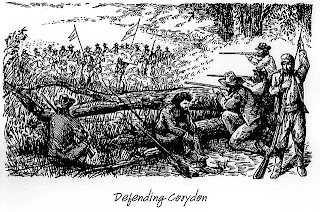
Sketch of the Corydon Battlefield[ii]
Morgan was in his glory in Corydon. He paroled his prisoners and demanded a ransom for the town. The Harrison County treasury was emptied of $690. Unsatisfied, he demanded “contributions” of $1,000 each from the three mills to spare them from being burned. He then demanded $600 each from the town’s two leading stores. These payments however did not prevent the Raiders from “collecting the spoils of victory.” Stores were looted, private homes pillaged and women ordered to empty their pantries and prepare meals. Morgan made his headquarters at the town's main hotel, while his men procured fresh horses. Local reports claimed that over 500 horses were taken.
“On the doubly memorable ninth of July a visit was paid to the citizens of Corydon and vicinity by Morgan and his herd of horse thieves. We heard Tuesday night that they had crossed the river and had disgraced the soil of Indiana with their most unhallowed feet. Our home guards skirmished with the rebs from the river to C. [Corydon] and on one of the hills overlooking the town had a grand battle. The battle raged violently for thirty minutes, just think of it! And on account of the large number of the rebs we were forced to retire which our men did in good earnest every one seemed determined to get out of town first but which succeeded remains undecided to this day. After the general skedaddle, Col. Jordan wisely put up the white Flag--and we were prisoners to a horde of thieves and murderers. I don't want you to think I am making fun of our brave home guards for I am not in the least, but now that all the danger is over, it is real funny to think how our men did run. Gen. Carrington awarded great praise to us and we all think that is something. What could 350 un-drilled home guards and citizens do against 4,000 well drilled and disciplined soldiers We did not even know Hobson was following him. We sent to New Albany time and again for help and not one man or gun did they send us. Though we have found out since that it was the fault of Gen Boyle and not the people of New Albany. It made Morgan so mad to think a few Home guards dared to fight his men I am glad they done it just to spite him. However they captured most of the guards and paroled them and killed three of our men. Father was out fighting with his Henry rifle but they did not get him or his gun. One of Morgan’s spies was in town three or four weeks visiting his relatives and some of his men helped our men to build the entrenchments I guess none of the rebels down south are that accommodating are they? One of our brave boys run three miles from the rebels, and really run himself to death. He stopped at a house and fainted and never came to. Didn’t he deserve a promotion? I think that was the awfullest [sic] day I ever passed in my life. ”
~ Miss Attia Porter[iii]
“I may state here that the numerous papers of Indiana were telling the people that Morgan's men were killing women and children and burning houses and destroying everything. These reports of course were false. But it scared the people almost crazy, consequently, they all or most of them left home. We would often see men, women and children running away across the fields and we would run after them and take the men behind us on our horses to some Capt. or Colonel who would parole them, the women and children would be frightened almost to death. We would tell them to return home that we were not fighting them or private citizen and would not hurt anyone who were not soldiers. Houses were deserted, door left opened, they left in such haste. Of course we had strict orders from General Morgan not to take anything, but we often visited the pantry and such good food, bread and meats, butter, honey, fruits, preserves and such. After passing through Corydon a few miles, as we was passing a large house an old man about 80 years old come out on the porch to our left, shot at the men at the head of the column, as they passed by. I saw him when he fired his gun, but was back in the column 4 or 5 hundred yards. The boys in front of the house shot at him and wounded him slightly in the cheek. They charged the house, took his gun and broke it. He sat down in a chair on the porch and looked at us pass by. The lady of the house could not get him to go into the house. His age saved him: he wounded one man slightly. We all admired his courage and bravery but not his judgment.”
~John Weatherred, 9th Tennessee Cavalry[iv]
While taking a meal at Jacob W. Kintner’s Eagle Hotel, John Hunt Morgan was brought a local newspaper by the innkeeper’s daughter. Morgan’s face filled with gloom as he read of the Confederate defeats at Gettysburg and Vicksburg.[v] Now there was no hope of joining forces with Lees and riding off into the pages of history. Morgan’s scheme of grandeur was undone.
INDIANAPOLIS, July 9. – Morgan’s forces consisting of infantry, artillery and cavalry and numbering between 6,000 and 8,000 crossed into Indiana and captured Corydon. Our forces are falling back. It is supposed the rebels are marching on New Albany and Jeffersonville, where large quanties of supplies are stored. Troops are being organized throughout the State and sent forward as rapidly as possible. Business was entirely suspended here today, and the citizens were forming companies for self defense. One regiment has been raised since last night. It is reported that two citizens were killed at Corydon when the rebels entered the town.
~The Cincinnati Daily Enquirer [vi]
“Morgan’s force was not to exceed two thousand troopers when he invaded the States north of the Ohio River. Now two thousand horsemen make a big showing; and to the excited male citizens, whose horses were being seized right and left, and to the excited female citizens, whose loaves of bread were being seized at the oven doors, this number was easily magnified to ten thousand; and this was the number uniformly reported to us by the excited citizens, though we knew the number did not exceed two thousand.”
~ Captain Theodore R. Allen, 7th Ohio Cavalry [vii]
Reports of dead and wounded include four of Jordan’s men killed during the battle and 10 -12 Union men wounded. Civilian fatalities included a toll keeper shot while tending his gate, a Lutheran Minister shot on his farm, and two women who died of “exhaustion.” The Raiders counted eleven dead and forty wounded. The Presbyterian Church on Capitol Avenue was pressed into service as the Confederate hospital where Morgan left his wounded in the care of the townspeople. Ordering his men to remount, Morgan pressed his main column northward toward New Salisbury. A number of details were sent out to search for fresh horses, food, and supplies including replacements for tattered clothes, shoes and hats. Other groups splintered off to plunder as they past small villages. The main column past through New Salisbury and camped south of Palmyra sending only a few hours on sleep. Early in the morning of July 10th, the Raiders regrouped in Salem before continuing their march.
“General Hobson’s pursuing column, of which the Seventh Ohio Cavalry was a part, arrived at Corydon a few hours after Morgan’s departure. The citizens of Indiana received us with the greatest joy and enthusiasm; and from the time of our arrival at Corydon until the end of our march at Buffington Island, Ohio, (a distance of about three hundred miles,) our line of march was between two lines of patriotic people, occupying each side of the road – men, women, and children – laden with good things for us to eat, the principal article being fried chicken. In truth and literally, there were six hundred miles of fired chicken! The reader may be inclined to look upon this statement as a ‘Cavalryman’s yarn’ or an exaggeration, but I trust it will not be so considered. I am surprised at my moderation in thus describing the fried chicken prepared for us on this march. In view of the fact that whichsoever way we turned or whatsoever road we followed, the women of Indiana and Ohio met us promptly with the greatest abundance of fried chicken I am inclined to think that it would be entirely within bounds of truth if I described the same as ‘Six Hundred Square Miles of Fried Chicken.’”
~ Captain Theodore F. Allen, Seventh Ohio Cavalry [viii]
ENDNOTES
[i] Diary of James B. McCreary
[ii] John Hunt Morgan Heritage Trail Project and the Historic Hoosier Hills Organization
[iii] Letter from Attia Porter to John Calvin Andrews 7/30/1863 http://ronald.andrews.googlepages.com/7301863attiaporter
[iv] The Wartime Diary of John Weatherred
[v] Benton, Leo. Informational Flyer on the history of Corydon
[vi] Daily Cincinnati Enquirer, July 10, 1863
[vii] Allen, Theodore F. “In Pursuit of John Morgan,” Sketches of War History 1861-1865, Papers prepared for the Commandery of the Sate of Ohio, Military Order of the Loyal Legion of the United States 1896 -1903, p. 232
[viii] Allen, Theodore F. “In Pursuit of John Morgan,” Sketches of War History 1861-1865, Papers prepared for the Commandery of the Sate of Ohio, Military Order of the Loyal Legion of the United States 1896 -1903, p. 229.
Subscribe to:
Posts (Atom)


 Posts
Posts